PUBLIC MEASUREMENT DATA · AUGUST 2026
China App Access Matrix: what current measurements actually show
Not a copied blocked-app list and not a claim that every app behaves the same. This snapshot aggregates public OONI measurements from probes in China and keeps anomalies, test failures and successful results separate.
THE 30-DAY SNAPSHOT
Three numbers worth noticing
Query window: 1–30 August 2026 UTC. Retrieved 31 August 2026.
EDITOR-READY CHART
Reuse the measurement snapshot
The vector version stays sharp in articles, newsletters and presentations. Non-commercial reuse must preserve the OONI source, attribution and ShareAlike license described below.
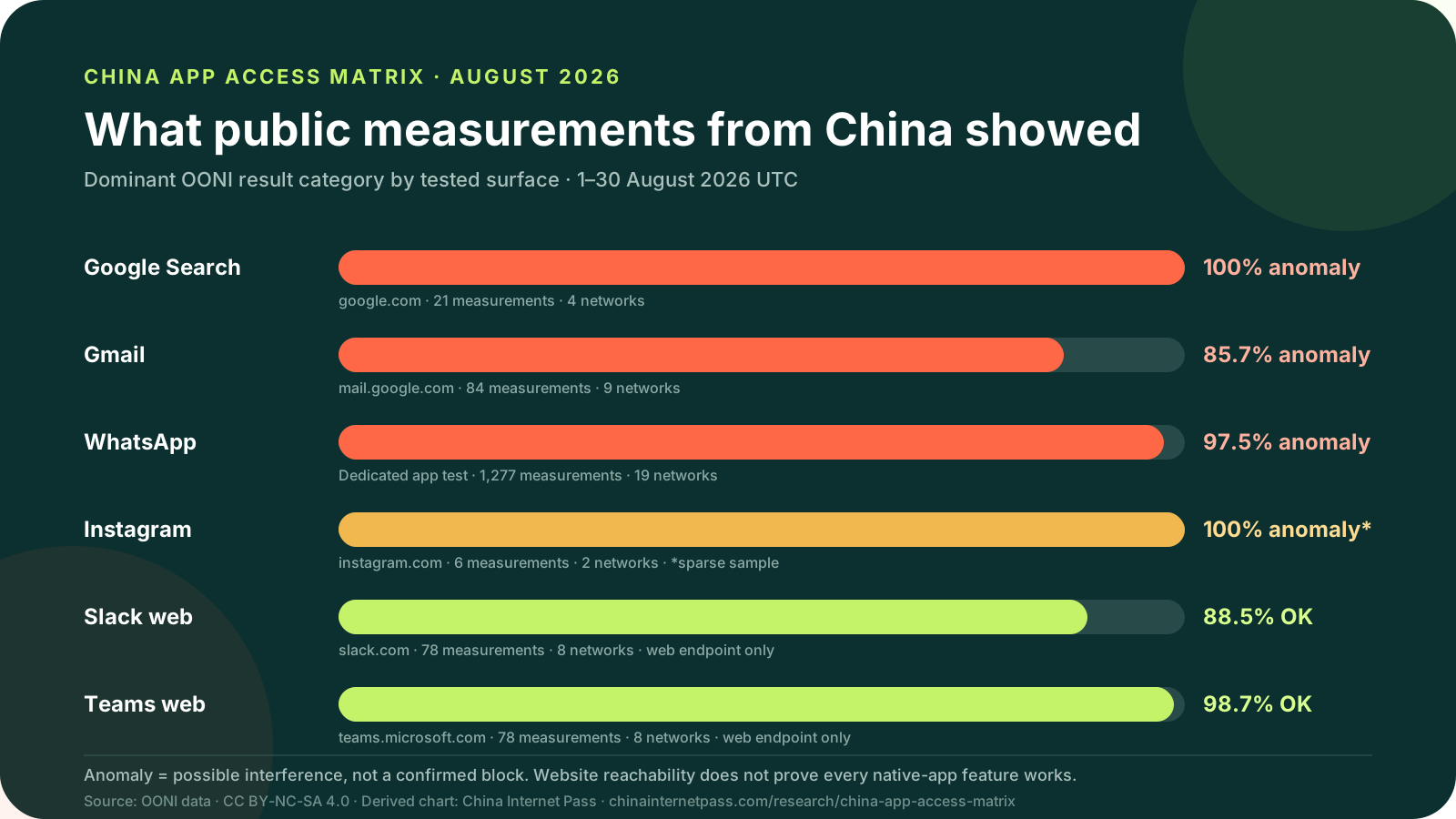
SERVICE BY SERVICE
The measurement matrix
OK, anomaly and failure are OONI result categories. “Measured networks” counts distinct probe ASNs in this query window.
| Service and surface | Coverage | Results | Interpretation |
|---|---|---|---|
| Google Searchgoogle.com web endpoint | 21measurements4 measured networks | OK0%0 Anomaly100%21 Failure0%0 | Strong interference signal Every recorded measurement was anomalous: 21 of 21 across 4 measured networks. A Web Connectivity result for google.com; it does not test every Google product endpoint. |
| Gmailmail.google.com web endpoint | 84measurements9 measured networks | OK2.4%2 Anomaly85.7%72 Failure11.9%10 | Strong interference signal 2 of 84 measurements were OK; 72 were anomalous and 10 were test failures. A Web Connectivity result for the Gmail web endpoint; native-app behavior can involve additional endpoints. |
| WhatsAppOONI WhatsApp app reachability test | 1,277measurements19 measured networks | OK2.5%32 Anomaly97.5%1,245 Failure0%0 | Strong interference signal 1,245 of 1,277 measurements were anomalous across 19 measured networks. OONI's dedicated WhatsApp test checks app endpoints; individual features and transient behavior can still differ. |
| Instagraminstagram.com web endpoint | 6measurements2 measured networks | OK0%0 Anomaly100%6 Failure0%0 | Sparse interference signal All 6 recorded measurements were anomalous, but the sample covered only 2 measured networks. Sparse Web Connectivity coverage; treat this as directional rather than a complete app-level result. |
| Slackslack.com web endpoint | 78measurements8 measured networks | OK88.5%69 Anomaly10.3%8 Failure1.3%1 | Mostly reachable web endpoint 69 of 78 web-endpoint measurements were OK across 8 measured networks. Website reachability does not prove that sign-in, workspace messaging, calls, files or every app endpoint works. |
| Microsoft Teamsteams.microsoft.com web endpoint | 78measurements8 measured networks | OK98.7%77 Anomaly1.3%1 Failure0%0 | Mostly reachable web endpoint 77 of 78 web-endpoint measurements were OK across 8 measured networks. Website reachability does not prove that meetings, media, authentication or every native-app endpoint works. |
DO NOT MIX THE LAYERS
What this says—and does not say—about your connection
Mainland Wi-Fi or local network
The OONI results are evidence from probes in China. They are most relevant to hotel Wi-Fi, local broadband and local mobile paths that remain inside the mainland network environment.
International roaming
A home carrier may route traffic outside mainland China, but the result depends on the carrier and plan. This dataset does not justify a universal “roaming always works” claim.
Travel eSIM
eSIM describes how a plan is installed, not where traffic exits or whether hotspot use is allowed. Verify the provider’s China routing and tethering terms.
Prepared access routes
No commercial access service is represented as independent OONI evidence in this matrix. Any product-specific route needs its own dated tests and methodology.
REPRODUCIBLE METHOD
How the snapshot was built
- 01Country and time
Probe country CN; measurements from 1 August up to, but not including, 31 August 2026; retrieved on 31 August.
- 02Web endpoints
OONI Web Connectivity aggregation for google.com, mail.google.com, instagram.com, slack.com and teams.microsoft.com, grouped by domain and probe ASN.
- 03WhatsApp app test
OONI’s dedicated WhatsApp reachability test, grouped by probe ASN. This is stronger app-level coverage than testing whatsapp.com alone.
- 04No category laundering
Failures are not counted as anomalies. Confirmed-block counts remain in the CSV even when zero. Our interpretation is labeled separately from OONI’s raw result categories.
Questions this matrix should prevent
Does anomaly mean confirmed blocking?
No. OONI explicitly warns that anomalies can include false positives. Consistent, high anomaly shares across multiple networks are stronger signals, but the exact measurement and failure type still matter.
If Slack or Teams web loads, is the whole app safe?
No. Website reachability is narrower than authentication, workspaces, calls, media, file delivery and native-app endpoints. That is why the surface tested appears next to every service.
Can I use this table to choose an eSIM?
Only as a warning about the mainland network environment. You still need the eSIM provider’s actual China routing, hotspot policy, high-speed allowance and device compatibility.